
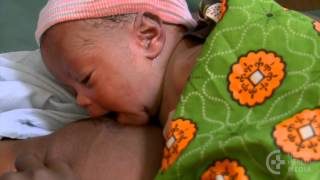
This video was produced by Global Health Media Project, and is intended primarily for frontline health workers in the developing world. The video and script (shown below) may be downloaded from their website: http://globalhealthmedia.org/videos/ .
Within the first few hours after birth, most healthy newborns can instinctively move to their mother’s breast and attach all on their own.
This early breastfeeding gives your baby a healthy start. The skin-to-skin contact keeps her at a perfect body temperature and stimulates her feeding instincts. Your baby will benefit from an early dose of colostrum, the rich and protective first milk. Her suckling will help contract your uterus and speed up delivery of the placenta.
Early breastfeeding is also important in helping you bond with your baby.
This video will show you the natural process of starting early breastfeeding through the journeys of 3 newborns. Immediately after the birth, the baby is placed on her mother’s bare abdomen. The birth attendant checks that she is well as she dries the baby with a clean cloth. She leaves the protective white coating on the baby’s skin.
Then she places a clean dry cloth over her. The baby finds her mother’s breast through her sense of smell. Her hands have the scent of amniotic fluid on them and will help her find her mother’s nipple, which has a similar scent. For this important reason, your babies’ hands should not be dried and it’s recommended that you do not wash your nipples before your baby breastfeeds. The baby is left quiet and undisturbed on her mother for at least an hour after the birth or until after the first feeding. The mother’s body keeps the baby at a perfect temperature.
Most babies are quietly alert in the first few hours. Watch how she opens her eyes, feels and smells her surroundings. Then she starts to move her feet, her hands and her body as she gradually moves herself to her mother’s breast. The baby may have periods of resting between periods of activity throughout the first hour or so. Notice her feeding signals: her mouth opens wide and she brings her hand to her mouth.
Using her sense of smell – which is well developed at birth – the baby moves towards her mother’s nipple, which has a similar scent to the baby’s hands. On her own, she finds the nipple and tries to grasp it with her hand and her mouth. Eventually she takes the nipple, attaches and starts to suck. It’s best to let the baby attach all by herself. Try not to help your baby onto your breast or push the back of her head. Doing this may confuse your baby and slow down her natural process of attaching at your breast. The baby should be kept on her mother’s chest for at least an hour even if she has finished feeding.
This mother pauses to rest a moment before pushing her baby out into the world. The baby is placed directly on her bare belly and dried with a clean cloth. She moves and cries right away.
Her hands are not dried –the scent of amniotic fluid is kept on them so she can find her mother’s nipple. The baby is covered with a clean dry cloth. The mother and baby are left quiet and undisturbed.
From the moment of birth, this baby is alert and active. She looks around, smells and feels her new surroundings. Watch her feeding signals: she salivates, explores her hand with her mouth, and sucks on her thumb. With her well-developed sense of smell, she starts to move towards her mother’s nipple. Now the baby brings her tongue forward to explore the nipple area. Even with her limited vision, the baby looks at her mother. Then the baby takes the nipple, attaches and starts to suck. The baby feeds until she is finished. Then the baby and the mother fall into a restful sleep.
Birth attendants should wait until babies have breastfed and had skin-to-skin contact for at least an hour before they provide routine newborn care. Your baby’s initial care, such as Vitamin K, or eye protection can take place right on your chest. Wait at least a day before giving your baby his first bath. If you need to move from the birth area to a postpartum room, position your baby skin-to-skin on your chest at the first possible opportunity. This will still benefit your baby. Let him attach all by himself. Be sure to feed your baby only breast milk. This will get breastfeeding off to a good start, protect her from sickness and build up your milk supply. Do not give her any water, sweetened water, tea, formula or anything other than your breast milk. Feeding only breastmilk for the first 6 months is vital to your baby’s health.


コメント